Introduction: What Is a Progressive Web App (PWA)?
A Progressive Web App (PWA) is a modern web application that delivers an app-like experience directly through a web browser. It combines the best features of web apps and native mobile applications, offering users fast loading speeds, offline access, push notifications, and seamless performance—without requiring installation from an app store.
So, what is a Progressive Web App, exactly? In simple terms, a PWA is a website built using advanced web technologies that behaves like a mobile app. It can be accessed via a browser, added to a device’s home screen, and even function offline. This makes PWAs an increasingly popular choice for businesses looking to enhance user experience while reducing development and maintenance costs.
With growing mobile usage, businesses need digital solutions that are fast, reliable, and engaging. PWA development has emerged as a powerful solution to meet these expectations, offering a flexible and future-ready approach to application development.
Why Progressive Web Apps Were Introduced
Traditional websites often struggle with performance, engagement, and offline functionality. On the other hand, native apps require separate development for iOS and Android, high maintenance costs, and app store approvals.
Progressive Web Apps were introduced to bridge this gap.
Key reasons behind the rise of PWAs:
- Poor mobile web performance – Many websites load slowly on mobile networks, leading to high bounce rates and low conversions.
- High cost of native app development – Building and maintaining separate apps for multiple platforms can be expensive and time-consuming.
- Low app adoption rates – Users are often reluctant to download apps due to storage concerns or one-time usage needs.
- Need for offline and low-network functionality – Users expect apps to work even with poor or no internet connectivity
PWAs solve these problems by delivering fast, reliable, and engaging experiences directly through the web, making them a game-changer in modern web development.
How PWAs Work (Service Workers, HTTPS, Manifest)
To understand PWA technology, it’s essential to know the core components that make a Progressive Web App function like a native app.
1. Service Workers
Service workers are JavaScript files that run in the background, separate from the main browser thread.
They enable:
- Offline access
- Background data sync
- Push notifications
- Faster loading through caching
Service workers intercept network requests and serve cached content when the network is unavailable or slow.
2. HTTPS
All Progressive Web Apps must be served over HTTPS to ensure secure communication between the user and the server. This prevents data tampering and enhances user trust.
Security is critical for:
- Push notifications
- Authentication
- Offline data storage
3. Web App Manifest
The web app manifest is a JSON file that defines how the PWA appears to users.
It controls:
- App name and icon
- Theme color
- Splash screen
- Display mode (fullscreen or standalone)
Together, service workers, HTTPS, and the web app manifest form the foundation of a reliable and scalable Progressive Web App.
Core Features of Progressive Web Apps
One of the biggest reasons behind the popularity of PWAs is their powerful feature set. Let’s explore the Progressive Web App features that set them apart.
Offline Access
Offline access is a defining feature of PWAs. Using intelligent caching strategies, users can:
- Browse content without internet
- Access previously loaded pages
- Continue using essential features offline
This is particularly useful for users in areas with unstable or slow network connections.
Push Notifications
PWAs support push notifications, enabling businesses to:
- Re-engage users
- Send real-time updates
- Improve retention rates
Unlike email or SMS, push notifications are instant and highly visible, making them a powerful engagement tool.
App-Like UI
Progressive Web Apps offer a smooth, app-like user interface with:
- Responsive design
- Touch-friendly navigation
- Smooth animations
Users often cannot distinguish between a PWA and a native app, enhancing overall experience.
Fast Loading
Speed is critical for user satisfaction and SEO. PWAs load quickly due to:
- Cached assets
- Reduced server requests
- Optimized resource delivery
Fast loading improves conversion rates and lowers bounce rates significantly.
Benefits of Progressive Web Apps for Businesses
The benefits of Progressive Web Apps go beyond technical advantages. They deliver tangible business value.
1. Lower Development Costs
With a single codebase, businesses can target multiple platforms without building separate native apps.
2. Improved SEO Performance
PWAs are indexable by search engines, unlike traditional native apps. This improves visibility and organic traffic.
3. Higher User Engagement
Features like offline access and push notifications significantly boost user engagement and session duration.
4. No App Store Dependency
Users can access PWAs instantly through a URL, eliminating app store approvals and download barriers.
5. Faster Time to Market
PWA development allows quicker deployment and updates, giving businesses a competitive edge.
For companies aiming to scale digitally, a Progressive Web App for business is a smart and cost-effective solution.
PWA vs Web Apps vs Native Apps
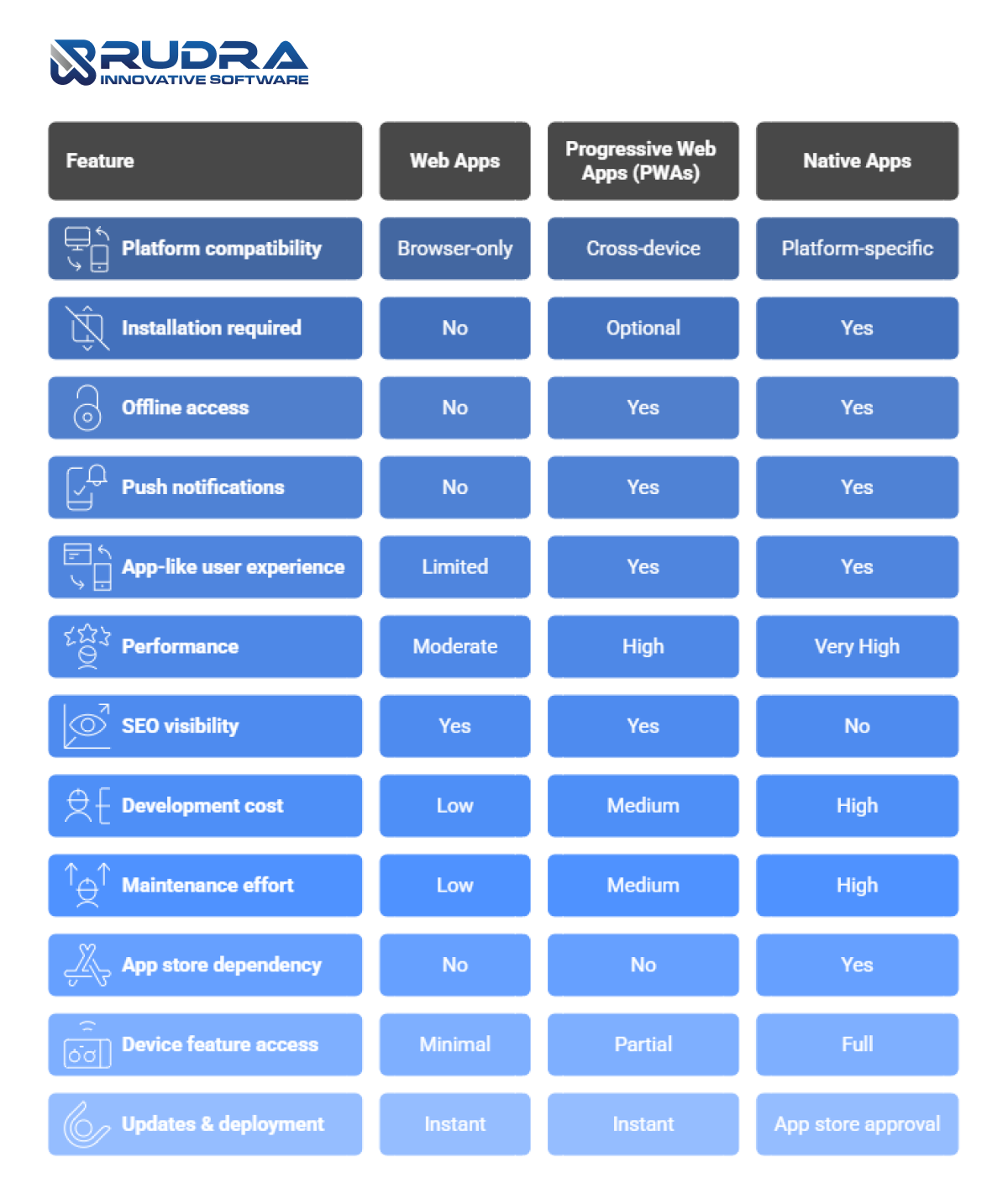
Choosing between a traditional web app, a Progressive Web App, and a native mobile app depends on performance needs, budget, user expectations, and long-term business goals. The comparison below clearly explains how each option differs.
Feature Comparison: PWA vs Web Apps vs Native Apps
Key Takeaways
- Web apps are suitable for basic informational websites but lack advanced functionality.
- Progressive Web Apps provide a perfect middle ground—combining performance, engagement, and cost-efficiency.
- Native apps are ideal for complex applications requiring deep hardware integration but come with higher costs.
For most businesses, PWAs offer the best balance between functionality and scalability.
Real-World Progressive Web App Examples
Many global brands have adopted PWAs to improve performance and engagement. These Progressive Web App examples highlight their real-world impact.
Starbucks launched a PWA to provide fast, offline access to menus and ordering. The result was increased mobile engagement and reduced data usage.
Twitter Lite is a well-known PWA that offers faster load times, lower data consumption, and push notifications—especially effective in emerging markets.
Pinterest’s PWA improved user engagement, time spent on site, and ad revenue by delivering a smooth, app-like experience.
Uber’s PWA allows users to book rides even on slow networks, demonstrating the power of lightweight, offline-capable applications.
Still deciding between Web, Native, Hybrid, or Progressive Web Apps?
Read our Web vs Native vs Hybrid Apps: Business Playbook to choose the right app strategy for your business.
When Should You Choose a PWA?
A Progressive Web App is not just a technical upgrade—it’s a strategic business decision. Choosing a PWA makes sense when your goal is to deliver a fast, reliable, and engaging user experience without the complexity of native app development.
You should choose a PWA if:
Your audience is mobile-first
If most of your users access your platform through mobile devices, a PWA ensures fast loading, smooth navigation, and app-like usability.
You want to improve engagement without app store friction
PWAs eliminate the need for downloads and approvals, allowing users to access your app instantly through a browser.
Your users have unreliable or slow internet connections
Offline access and smart caching make PWAs ideal for users in low-bandwidth regions.
You need faster time-to-market
PWA development enables quick launches and seamless updates without waiting for app store reviews.
SEO and discoverability matter
Unlike native apps, PWAs are fully indexable, helping your business rank better on search engines.
You want to reduce development and maintenance costs
A single PWA can replace multiple platform-specific apps, making it a cost-effective long-term solution.
For industries like ecommerce, SaaS, education, travel, healthcare, and media, a Progressive Web App for business can deliver exceptional ROI.
Challenges and Limitations of PWAs
Despite their advantages, PWAs have some limitations.
Limited iOS Support
While iOS support for PWAs has improved, some features like advanced push notifications and hardware access are still limited.
Restricted Device Access
PWAs may not have full access to device hardware compared to native apps, such as Bluetooth or advanced sensors.
App Store Visibility
PWAs don’t naturally appear in app stores unless wrapped using additional technologies.
However, for most business applications, these limitations are manageable and outweighed by the benefits.
Future of Progressive Web Apps
The future of Progressive Web Apps is extremely promising as web technologies continue to evolve and browser support expands. PWAs are no longer an alternative—they are becoming a standard for modern digital experiences.’
Key trends shaping the future of PWAs:
Improved iOS and browser support – Apple and other browser vendors are gradually expanding PWA capabilities, including better push notifications and background processes.
Deeper access to device hardware – Emerging APIs are enabling PWAs to access features like Bluetooth, NFC, biometrics, and file systems—bringing them closer to native apps.
Growing enterprise adoption – Enterprises are adopting PWAs to reduce operational costs while maintaining high performance across platforms.
Integration with AI and cloud services – PWAs are increasingly being combined with AI, analytics, and cloud infrastructure to deliver personalized and intelligent user experiences.
App-store-less future – As users prefer instant access over downloads, PWAs will continue to gain popularity as install-free applications.
Enhanced performance and security standards – Advancements in PWA technology will further improve speed, reliability, and data protection.
As these trends accelerate, Progressive Web Apps will play a critical role in shaping the future of digital product development.
Conclusion
Progressive Web Apps are transforming the way businesses deliver digital experiences. By combining the reach of the web with the functionality of native apps, PWAs offer speed, reliability, and engagement at a lower cost. Whether you’re a startup or an enterprise, adopting a Progressive Web App for business can improve performance, increase user retention, and drive conversions.
Planning an App in 2026?
Get expert advice on choosing the right app strategy for performance, scalability, and growth.
Frequently Asked Questions (FAQs)
1. What is a Progressive Web App (PWA)?
A Progressive Web App (PWA) is a web application that delivers an app-like experience using modern web technologies such as service workers, HTTPS, and web app manifests. It works across devices and platforms without requiring app store installation.
2. How is a PWA different from a traditional web app?
Unlike traditional web apps, PWAs support offline access, push notifications, fast loading, and home screen installation, offering a more engaging and reliable user experience.
3. Is a Progressive Web App better than a native app?
PWAs are more cost-effective and easier to maintain than native apps, but native apps may still be better for applications requiring deep hardware integration. For most business use cases, PWAs provide an excellent balance.
4. Can PWAs work offline?
Yes. Progressive Web Apps use service workers to cache content, enabling users to access key features and data even without an internet connection.
5. Which businesses should use Progressive Web Apps?
PWAs are ideal for ecommerce, SaaS, education, travel, media, healthcare, and startups looking for fast performance, cross-platform compatibility, and lower development costs.