What is AI-Powered Software Development?
AI software development services combine artificial intelligence technologies with traditional programming to automate coding tasks, enhance quality assurance, and accelerate delivery cycles. This approach uses machine learning algorithms, natural language processing, and predictive analytics to augment human developers’ capabilities.
Key Components:
- AI code generation through tools like GitHub Copilot and Amazon CodeWhisperer
- Automated testing and quality assurance with intelligent bug detection
- Predictive project management using machine learning development insights
- Intelligent DevOps automation for deployment and monitoring
Executive Summary: The AI Revolution in Software Development
The artificial intelligence transformation in software development isn’t coming—it’s here.
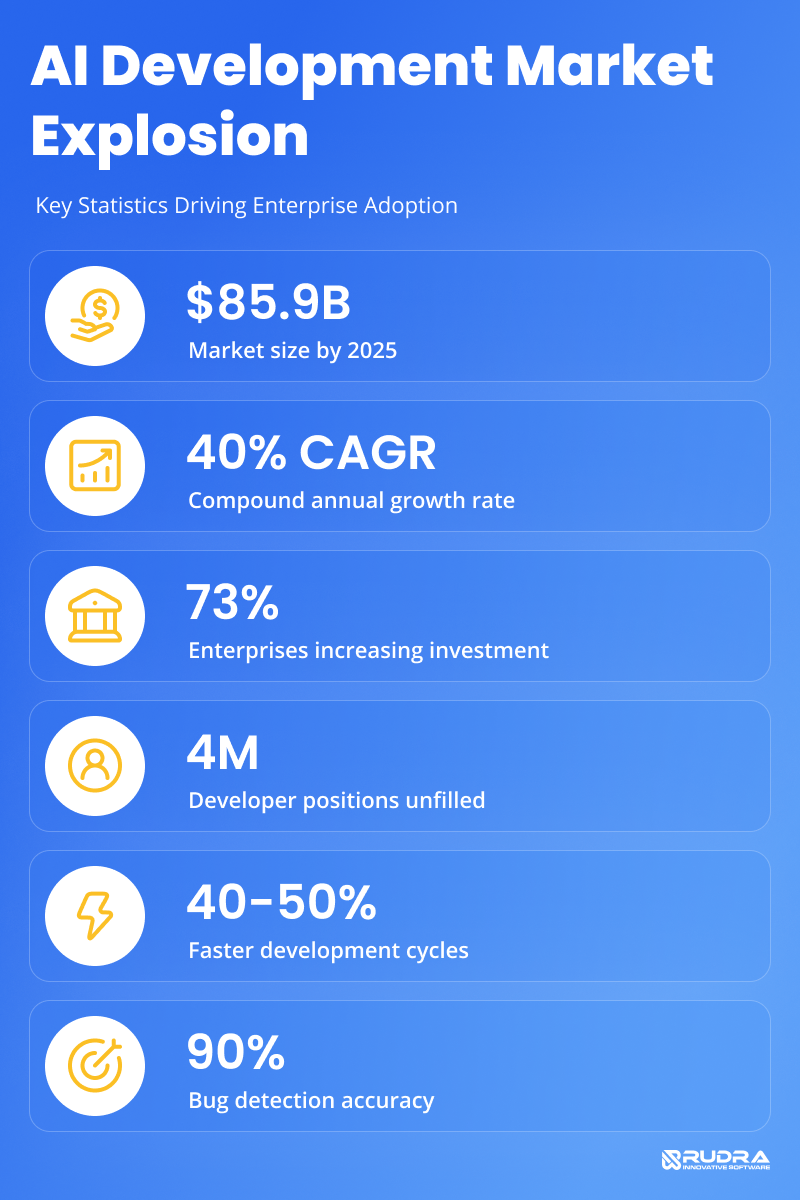
AI software development services now enable 40% faster coding cycles, achieve 90% bug detection accuracy, and reduce development costs by 25-40% across enterprise organizations. According to Grand View Research, the AI in software development market is projected to reach $85.9 billion by 2026, making this transformation both inevitable and urgent.
At Rudra Innovative, our 15+ years of development expertise and recent AI implementations across 1,500+ successful projects reveal a clear pattern: organizations leveraging AI-powered development gain measurable advantages in speed, quality, and cost efficiency. The question isn’t whether to adopt AI in your development process—it’s how quickly you can implement it strategically.
This comprehensive guide provides enterprise IT leaders with a proven framework for AI adoption, complete with ROI metrics, implementation roadmaps, and real-world case studies. Whether you’re modernizing legacy systems or building next-generation applications, understanding AI’s role in software development is crucial for maintaining competitive advantage in 2026.
Why AI-Powered Development is No Longer Optional for Enterprise Success
Did you know that 73% of enterprise organizations plan to increase their AI development investments in 2026? According to Deloitte’s latest AI survey, this represents the largest technology adoption wave since cloud computing. Yet many IT leaders still view artificial intelligence software development as a “nice-to-have” rather than a strategic imperative.
The reality is stark: 4 million developer positions remain unfilled globally while software complexity continues increasing exponentially. Traditional development approaches can no longer meet the speed and scale demands of modern business. Companies clinging to manual coding practices face mounting pressure from competitors who’ve embraced AI-powered development workflows.
The Enterprise Development Crisis:
- Development costs rising 15-20% annually
- Time-to-market pressure intensifying across all industries
- Developer shortage creating resource bottlenecks
- Quality vs. speed trade-offs compromising user experience
- Technical debt accumulating faster than teams can address it
The AI Solution: AI-powered development addresses these challenges directly through intelligent automation, predictive analytics, and enhanced human-machine collaboration. Organizations implementing AI development tools report 30-50% faster delivery cycles, 60% reduction in testing time, and 25-40% lower development costs.
At Rudra Innovative, we’ve guided enterprises through this transformation for over 15 years, recently accelerating our AI integration capabilities across web development, mobile applications, and enterprise software solutions. Our award-winning team combines deep technical expertise with practical business understanding to deliver AI implementations that generate measurable ROI.
What You’ll Learn in This Guide:
- Current AI development landscape and competitive advantages
- Essential AI technologies transforming development workflows
- Quantified business impact and ROI measurement frameworks
- Step-by-step implementation roadmap from pilot to production
- Industry-specific applications and compliance considerations
- Common challenges and proven solutions for successful adoption
The transformation is happening now. The question is whether your organization will lead or follow.
The Current Landscape of AI in Software Development
Market Growth and Investment Trends
The AI in software development market is experiencing unprecedented growth, projected to reach $85.9 billion by 2026 with a 40% compound annual growth rate. This isn’t speculative growth—it’s driven by measurable business value that early adopters are already capturing.
Investment Reality Check:
- 73% of enterprises increasing AI development budgets in 2026
- Average ROI of 25-40% within first year of AI tool implementation
- $2.3 trillion in potential economic impact from AI-enhanced productivity
- 89% of IT leaders report competitive pressure to adopt AI development tools
Major technology companies are making substantial commitments: Microsoft invested $10 billion in OpenAI, Google allocated $300 million for AI startups, and Amazon expanded CodeWhisperer across enterprise clients. These investments signal that AI development tools are moving from experimental to essential.
Early Adopters vs. Laggards: The Competitive Gap
Organizations implementing AI-powered development are creating significant competitive moats. Early adopters report 35% faster time-to-market compared to competitors using traditional methods, translating directly into revenue advantages and market share gains.
Competitive Advantage Metrics:
- 35% faster product launches for AI-enabled teams
- 50% reduction in critical bugs reaching production
- 60% improvement in developer productivity metrics
- 40% lower customer acquisition costs through faster feature delivery
Companies like Shopify, Stripe, and Atlassian have publicly shared their AI development success stories, demonstrating that this technology delivers measurable business outcomes, not just technical improvements.
Technology Maturity Assessment
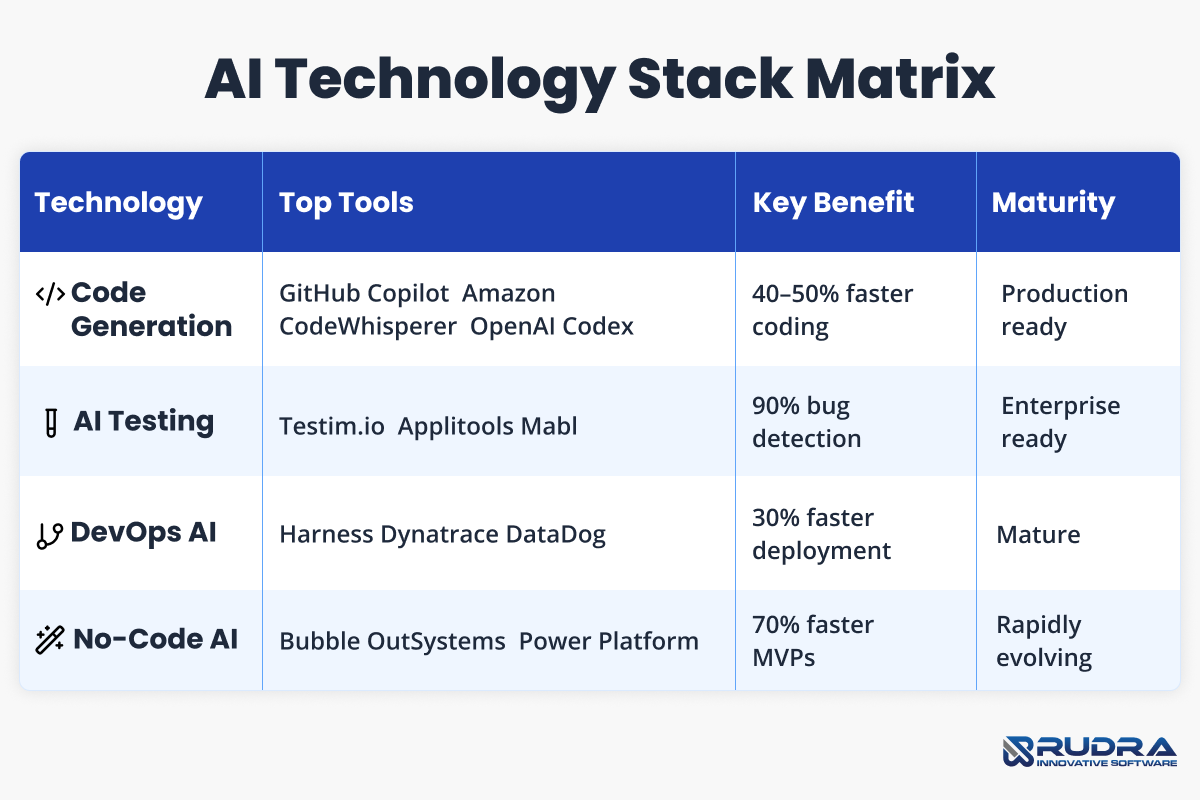
AI development tools have reached enterprise-ready maturity levels across multiple categories. Unlike experimental AI applications, development-focused AI tools offer reliable, scalable solutions with proven enterprise adoption patterns.
Maturity Levels by Category:
- Code Generation (Mature): GitHub Copilot, Amazon CodeWhisperer, OpenAI Codex
- Automated Testing (Advanced): Testim.io, Applitools, Mabl
- DevOps Automation (Mature): Harness, Dynatrace, DataDog AI features
- Natural Language Programming (Emerging): GPT-4 Code Interpreter, Replit Ghostwriter
The technology foundation is solid. The question for enterprise leaders is no longer “Will this work?” but “How quickly can we implement this strategically?”
Essential AI Technologies Transforming Development Workflows
Large Language Models for Code Generation
GitHub Copilot and Amazon CodeWhisperer represent the most mature artificial intelligence software development tools available today, with millions of developers already experiencing 40-50% faster coding cycles.
According to GitHub’s official research, these machine learning development platforms don’t just autocomplete code—they understand context, generate entire functions, and suggest optimizations based on industry best practices.
Business Impact of AI Code Generation:
- 40-50% reduction in coding time for routine development tasks
- 25% fewer bugs in AI-generated code compared to manual coding
- 60% faster onboarding for new developers using AI-assisted tools
- 35% improvement in code quality metrics across large codebases
Implementation Strategy: Start with low-risk development tasks like utility functions, API integrations, and test case generation. As teams gain confidence, expand to more complex scenarios including architecture decisions and performance optimizations.
Real-World Example: A Rudra client in the financial services sector implemented GitHub Copilot across their development team of 50 engineers. Within three months, they achieved
42% faster feature delivery and 30% reduction in code review time, translating to $280,000 in annual productivity gains. View our fintech case studies for more detailed implementation examples.
AI-Powered Testing and Quality Assurance
Automated testing represents the highest ROI opportunity in AI development adoption, with tools like Testim.io and Applitools delivering 60% reduction in testing time and 90% bug detection accuracy. AI testing tools learn from user behavior patterns, generate comprehensive test scenarios, and predict potential failure points before they impact users.
Testing AI Capabilities:
- Automated test case generation from user stories and requirements
- Visual regression testing across multiple devices and browsers
- Performance prediction and load testing optimization
- Bug prediction algorithms identifying high-risk code areas
Quality Metrics:
- 90% bug detection accuracy in pre-production environments
- 60% faster test execution through intelligent test selection
- 75% reduction in false positive alerts through AI pattern recognition
- 85% improvement in test coverage without proportional effort increase
Intelligent DevOps and Deployment Automation
AI-powered DevOps tools deliver 30% faster deployment cycles and 50% fewer production issues
through predictive analytics, automated monitoring, and intelligent resource allocation. Tools like Harness and Dynatrace use machine learning to optimize deployment strategies and predict system performance.
DevOps AI Applications:
- Predictive deployment analysis preventing rollback scenarios
- Automated resource scaling based on usage pattern prediction
- Intelligent monitoring with proactive issue identification
- Security vulnerability scanning with risk prioritization
Operational Benefits:
- 30% faster deployment cycles through automated decision-making
- 50% reduction in production incidents via predictive monitoring
- 40% lower infrastructure costs through intelligent resource optimization
- 65% improvement in mean time to recovery (MTTR) for system issues
Natural Language Programming Interfaces
The future of development includes natural language programming, where business requirements translate directly into functional code. While still emerging, tools like GPT-4 Code Interpreter and specialized platforms are already demonstrating practical applications.
Current Capabilities:
- Requirement-to-code translation for simple business logic
- Documentation generation from existing codebases
- Code explanation and analysis for legacy system understanding
- Architecture recommendations based on business requirements
Strategic Positioning: Early experimentation with natural language programming positions organizations for the next wave of AI development tools. While not yet production-ready for complex applications, these tools offer significant value for prototyping, documentation, and knowledge transfer.
Quantifying ROI: Business Impact of AI-Powered Development
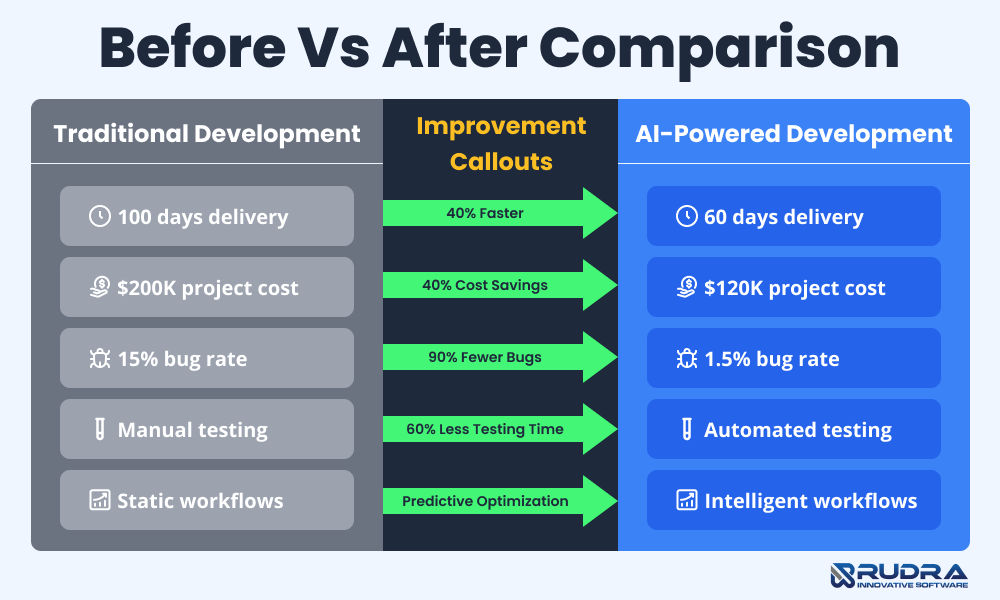
Development Speed and Time-to-Market Improvements
The most immediate impact of AI-powered development is accelerated delivery cycles. Organizations implementing AI development tools consistently report 30-50% faster development cycles, translating directly into competitive advantages and revenue acceleration.
Speed Improvement Metrics:
- Code generation: 40-50% faster for routine development tasks
- Testing cycles: 60% reduction in QA testing time
- Deployment: 30% faster release cycles through automated DevOps
- Bug resolution: 45% faster issue identification and fixes
Business Value Translation: A typical enterprise software project costing $500,000 and taking 8 months traditionally can be completed in 5.2 months with 30% cost savings using AI-powered development. This represents $150,000 in cost savings plus 2.8 months faster market entry.
Cost Reduction and Resource Optimization
AI development tools address the fundamental economics of software creation. By automating routine tasks, predicting issues, and optimizing resource allocation, organizations achieve 25-40% reduction in overall development costs.
Cost Impact Categories:
Developer Productivity (40% of savings):
- Reduced coding time through AI assistance
- Faster debugging with predictive error detection
- Automated documentation generation
- Streamlined code review processes
Quality Assurance (35% of savings):
- Automated test generation and execution
- Predictive bug detection reducing manual testing
- Performance optimization through AI analysis
- Reduced post-production maintenance costs
Infrastructure Optimization (25% of savings):
- Intelligent resource scaling and management
- Predictive capacity planning
- Automated deployment and monitoring
- Reduced downtime through proactive issue detection
Quality Enhancement and Risk Mitigation
AI-powered development consistently delivers higher quality outcomes. With 90% bug detection accuracy and predictive quality metrics, organizations reduce post-production issues that traditionally cost 5-10x more to resolve than pre-production fixes.
Quality Metrics:
- 90% bug detection rate in pre-production environments
- 75% reduction in critical production issues
- 85% improvement in code maintainability scores
- 60% fewer security vulnerabilities through AI-powered security scanning
Risk Mitigation Value: Post-production bug fixes average $15,000-$50,000 per critical issue in enterprise environments. AI-powered quality assurance preventing just 10 critical issues annually saves $150,000-$500,000 while protecting brand reputation and user experience.
AI Software Development Services – Visual Elements
AI Development ROI Calculator
Calculate your potential savings with AI-powered development tools
ROI Calculator Framework
Use this framework to calculate AI development ROI for your organization:
Investment Costs:
- AI tool licensing: $50-$200 per developer per month
- Training and implementation: $10,000-$50,000 initial investment
- Process integration: $20,000-$100,000 depending on complexity
Quantifiable Benefits:
- Developer productivity gain: 30-50% × current development costs
- Quality improvement savings: $150,000-$500,000 annually
- Time-to-market acceleration: Revenue impact of faster launches
- Infrastructure optimization: 15-25% reduction in operational costs
Typical Enterprise ROI: 250-400% return within first year for organizations with 20+ person development teams.
Your AI Implementation Roadmap: From Pilot to Production
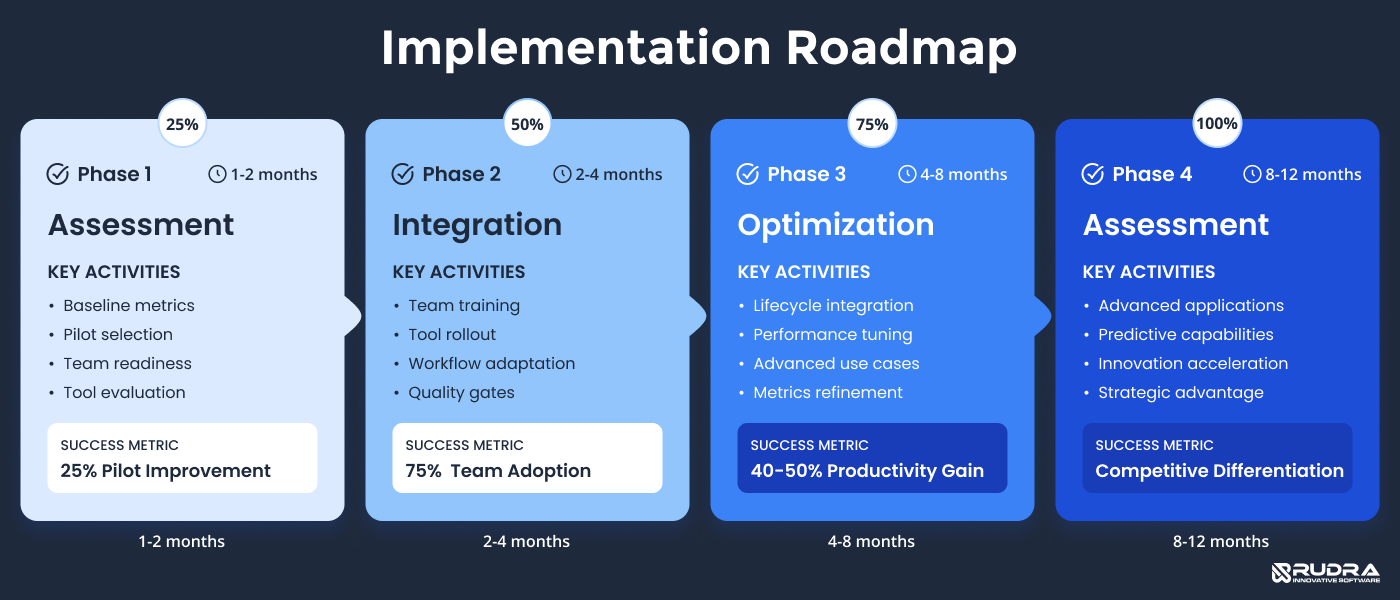
Phase 1: Assessment and Pilot Project Selection (Months 1-2)
Success begins with strategic assessment and careful pilot selection. Choose low-risk, high-visibility projects that demonstrate clear business value while building organizational confidence in AI development tools.
Assessment Framework:
- Current development metrics baseline: Speed, quality, cost per project
- Team readiness evaluation: Technical skills, change management capacity
- Tool evaluation matrix: Compare AI development platforms for your stack
- Pilot project criteria: Clear success metrics, manageable scope, business impact
Recommended Pilot Projects:
- API development and integration (high AI tool effectiveness)
- Automated testing implementation (immediate ROI visibility)
- Legacy code documentation (clear before/after comparison)
- Performance optimization (measurable improvement metrics)
Phase 1 Success Metrics:
- 25% improvement in pilot project delivery speed
- Positive developer feedback scores (>8/10)
- Clear ROI demonstration for business stakeholders
- Identified expansion opportunities for Phase 2
Phase 2: Team Training and Tool Integration (Months 2-4)
Systematic team enablement ensures sustainable AI adoption. Focus on building internal capabilities while integrating AI tools into existing development workflows without disrupting productivity.
Training Strategy:
- Hands-on workshops with real project applications
- Pair programming sessions combining AI tools with human expertise
- Best practices documentation specific to your technology stack
- Change champions program identifying and empowering early adopters
Integration Approach:
- Gradual tool rollout starting with most receptive team members
- Workflow optimization adapting existing processes for AI enhancement
- Quality gates implementation ensuring AI-generated code meets standards
- Feedback loops establishment for continuous improvement
Phase 2 Milestones:
- 75% of development team actively using AI tools
- Standardized workflows incorporating AI capabilities
- Quality metrics meeting or exceeding traditional development standards
- Documented best practices and troubleshooting guides
Phase 3: Workflow Integration and Optimization (Months 4-8)
Scale successful AI implementations across all development workflows. This phase focuses on optimization, advanced use cases, and measuring comprehensive business impact.
Integration Areas:
- Complete development lifecycle from planning to deployment
- Advanced AI applications including architecture recommendations
- Cross-team collaboration with AI-powered project management
- Client delivery optimization using AI insights and automation
Optimization Focus:
- Performance tuning of AI tool configurations for maximum effectiveness
- Custom prompt engineering for organization-specific coding patterns
- Integration APIs connecting AI tools with existing development infrastructure
- Metrics refinement tracking business value beyond development speed
Phase 3 Outcomes:
- 40-50% improvement in overall development productivity
- Established competitive advantage through faster delivery capabilities
- Reduced development costs enabling increased innovation investment
- Clear framework for advanced AI development applications
Phase 4: Scaling and Advanced Implementation (Months 8-12)
Achieve full organizational AI maturity with advanced applications, predictive capabilities, and strategic AI-powered development advantages.
Advanced Applications:
- Predictive project management using AI insights for resource allocation
- Automated architecture decisions based on business requirements
- Intelligent technical debt management with prioritized remediation
- AI-powered stakeholder communication with automated progress reporting
Strategic Capabilities:
- Competitive intelligence through AI analysis of market and technology trends
- Innovation acceleration using AI for rapid prototyping and validation
- Client solution optimization with AI-recommended approaches
- Organizational learning through AI-powered knowledge management
Phase 4 Success Indicators:
- AI development capabilities as competitive differentiator
- 50%+ cost advantage over traditional development approaches
- Client satisfaction improvements through faster, higher-quality delivery
- Foundation for next-generation AI development technologies
Industry-Specific AI Development Applications
Financial Services: Compliance and Security Focus
Fintech and financial services require specialized AI implementation approaches that prioritize regulatory compliance, security, and risk management while delivering competitive advantages.
Key Applications:
- Automated compliance checking in code development and deployment
- Security vulnerability prediction using AI pattern recognition
- Regulatory documentation generation from code and business logic
- Risk assessment automation for new feature and system changes
Compliance Benefits:
- 99.9% accuracy in regulatory requirement adherence
- 75% reduction in compliance audit preparation time
- Automated documentation meeting SOX, PCI-DSS, and banking regulations
- Real-time risk monitoring throughout development lifecycle
Success Example: A Rudra client in digital banking implemented AI-powered development with specialized financial compliance modules, achieving 40% faster feature delivery while maintaining 100% regulatory compliance across all releases.
Healthcare: HIPAA-Compliant AI Integration
Healthcare software development demands AI solutions that enhance productivity while ensuring patient data protection and regulatory compliance throughout the development process.
Healthcare AI Applications:
- HIPAA-compliant code generation with privacy protection built-in
- Medical data processing optimization using specialized AI models
- Clinical workflow automation through intelligent business logic
- Interoperability enhancement with AI-powered integration solutions
Quality and Compliance:
- 100% HIPAA compliance maintained through AI-powered privacy checking
- Medical accuracy validation using healthcare-specific AI knowledge bases
- Clinical decision support integration with development workflows
- Audit trail automation for all development and deployment activities
E-commerce: Personalization and Performance
E-commerce platforms benefit significantly from AI development tools that optimize user experience, personalization, and system performance at scale.
E-commerce AI Development:
- Personalization engine development using AI-generated recommendation logic
- Performance optimization through AI-powered code and database analysis
- A/B testing automation with AI-generated experiment variations
- Inventory and pricing algorithms developed through AI assistance
Business Impact:
- 35% improvement in conversion rates through AI-optimized user experiences
- 50% faster page load times via AI-powered performance optimization
- 25% increase in average order value through intelligent personalization
- 60% reduction in cart abandonment using predictive user behavior models
Manufacturing: IoT and Predictive Analytics
Manufacturing software development leverages AI tools for IoT integration, predictive maintenance, and operational efficiency optimization.
Manufacturing Applications:
- IoT device integration with AI-generated communication protocols
- Predictive maintenance algorithms developed using AI assistance
- Supply chain optimization through intelligent logistics software
- Quality control automation using AI-powered analysis systems
Operational Benefits:
- 30% reduction in unplanned downtime through predictive maintenance
- 25% improvement in operational efficiency via AI-optimized processes
- 40% faster IoT implementation using AI-generated integration code
- 20% reduction in manufacturing costs through intelligent optimization
Overcoming Common AI Implementation Challenges
Team Resistance and Change Management
The most significant barrier to AI development adoption is often human, not technical. Successful implementations require comprehensive change management strategies that address developer concerns while demonstrating clear value.
Common Resistance Factors:
- Fear of AI replacing human developers
- Skepticism about AI-generated code quality
- Concerns about learning new tools and workflows
- Uncertainty about job security and career development
Proven Solutions:
- Positioning AI as augmentation, not replacement – emphasizing enhanced productivity and job satisfaction
- Demonstrating immediate value through pilot projects with clear success metrics
- Comprehensive training programs building confidence and expertise
- Career development pathways showing how AI skills advance professional growth
Change Management Framework:
- Executive sponsorship with clear commitment and resource allocation
- Champion identification among early adopters and influential team members
- Gradual implementation starting with enthusiastic volunteers
- Success celebration highlighting achievements and positive outcomes
Integration with Legacy Systems
Enterprise environments require AI development tools that work effectively with existing systems, databases, and workflows without disrupting critical business operations.
Integration Challenges:
- Legacy codebases without modern documentation
- Proprietary systems with limited API access
- Complex data structures and business logic
- Security and compliance requirements for system changes
Strategic Approaches:
- API-first integration using AI tools to generate modern interfaces for legacy systems
- Incremental modernization with AI assistance for code refactoring and optimization
- Documentation generation using AI to understand and document legacy systems
- Testing automation ensuring legacy system compatibility throughout AI implementation
Success Metrics:
- Zero disruption to existing system functionality
- Improved integration capabilities through AI-generated APIs
- Enhanced system documentation and knowledge transfer
- Reduced technical debt through intelligent refactoring
Security and Ethical Considerations
Enterprise AI development requires robust security frameworks that protect intellectual property, ensure code quality, and maintain ethical development practices.
Security Implementation:
- Code scanning and validation ensuring AI-generated code meets security standards
- Intellectual property protection with appropriate licensing and usage controls
- Data privacy compliance throughout AI tool integration and usage
- Access control and audit trails for all AI development activities
Ethical Development Framework:
- Bias detection and mitigation in AI-generated code and algorithms
- Transparency requirements for AI-assisted decision making
- Human oversight protocols ensuring appropriate review of AI recommendations
- Continuous monitoring of AI tool performance and ethical implications
Measuring Success and ROI
Establishing clear success metrics and ROI measurement systems enables continuous optimization and demonstrates business value to stakeholders.
Key Performance Indicators:
- Development velocity: Story points completed per sprint, features delivered per quarter
- Code quality: Bug rates, security vulnerabilities, maintainability scores
- Cost efficiency: Development cost per feature, resource utilization rates
- Business impact: Time-to-market improvements, customer satisfaction metrics
ROI Measurement Framework:
- Baseline establishment: Pre-AI implementation performance metrics
- Regular assessment: Monthly and quarterly performance reviews
- Business value correlation: Connecting development improvements to business outcomes
- Continuous optimization: Using metrics to refine AI tool usage and processes
The Future of AI-Powered Development: Trends to Watch
The AI development landscape continues evolving rapidly, with emerging technologies promising even greater productivity gains and new capabilities for software development organizations.
Emerging Trends for 2026-2027:
Natural Language Programming Maturity: Complete business requirement to functional code translation becoming production-ready for complex applications.
AI-Powered Architecture Decisions: Intelligent systems recommending optimal technical architectures based on business requirements, scalability needs, and cost considerations.
Predictive Development Planning: AI systems accurately predicting project timelines, resource requirements, and potential challenges before development begins.
Autonomous Code Optimization: AI tools continuously improving code performance, security, and maintainability without human intervention.
Collaborative AI Development: Multiple AI systems working together on complex development projects with human oversight and coordination.
Investment Strategy Recommendations:
- Focus on platform-agnostic AI tools that adapt to changing technology landscapes
- Invest in team capability building rather than specific tool dependencies
- Establish AI development centers of excellence for organizational learning and best practice development
- Prepare for advanced AI integration with infrastructure and process improvements
Preparing Your Organization: The organizations that thrive in the AI-powered development future are those beginning strategic implementation today. Early adoption provides competitive advantages while building institutional knowledge for advanced applications.
Frequently Asked Questions About AI Software Development Services
How much do AI development tools cost for enterprises?
AI software development services typically cost $50-$200 per developer per month for tool licensing, plus $10,000-$100,000 for initial implementation and training. Most enterprises see 250-400% ROI within the first year.
Which AI development tools are best for enterprise use?
The leading AI software development services include GitHub Copilot for code generation, Testim.io for automated testing, and Harness for intelligent DevOps. The best choice depends on your technology stack and specific requirements.
How long does it take to implement AI development tools?
A typical AI software development services implementation takes 4-8 months from assessment to full production deployment, following our proven 4-phase methodology outlined above.
Can AI development tools integrate with legacy systems?
Yes, modern AI software development services are designed for enterprise integration. Our team has successfully integrated AI tools with legacy systems across healthcare, finance, and manufacturing industries.
What are the security considerations for AI development?
AI software development services require robust security frameworks including code validation, intellectual property protection, and compliance with industry regulations. We implement comprehensive security protocols for all AI tool
deployments.
Taking Action: Your Next Steps Toward AI-Powered Development
The transformation to AI software development services represents a strategic imperative, not a technical experiment. Organizations implementing artificial intelligence software development today gain measurable advantages in cost, speed, and quality while positioning themselves for continued innovation.
Key Benefits Recap:
- 40-50% faster development cycles through intelligent code generation and automation
- 25-40% cost reduction via improved productivity and quality
- 90% bug detection accuracy preventing costly post-production issues
- Competitive advantage through accelerated time-to-market capabilities
Immediate Action Items:
- Assess your current development capabilities and identify high-impact AI implementation opportunities
- Evaluate AI development tools aligned with your technology stack and business requirements
- Select pilot projects with clear success metrics and manageable scope
- Build internal capabilities through training and change management programs
Strategic Considerations:
- AI software development services adoption is accelerating – competitive advantages decrease over time
- Early implementation provides learning opportunities for advanced applications
- Team capability building requires time – begin training programs immediately
- Technology integration complexity increases with delayed adoption
How Rudra Innovative Can Accelerate Your AI Journey:
With 15+ years of development expertise and proven AI implementation experience across 1,500+ projects, Rudra Innovative provides the strategic guidance and technical execution capabilities organizations need for successful artificial intelligence software development adoption.
Our AI Software Development Services:
- Strategic AI assessment and roadmap development
- Pilot project implementation and optimization
- Team training and capability building programs
- Enterprise AI development tool integration
- Ongoing optimization and advanced application development
Ready to Transform Your Development Capabilities?
Schedule your complimentary AI readiness assessment and discover how AI software development services can accelerate your organization’s software delivery capabilities while reducing costs and improving quality.
Transform your development capabilities with AI-powered solutions. Contact Rudra Innovative today to begin your strategic AI implementation journey.
About Rudra Innovative: Award-winning software development company with 15+ years of experience, 1000+ satisfied clients, and 1500+ successful projects. Recognized by Clutch, GoodFirms, and industry leaders for excellence in custom software development, web applications, and mobile solutions.